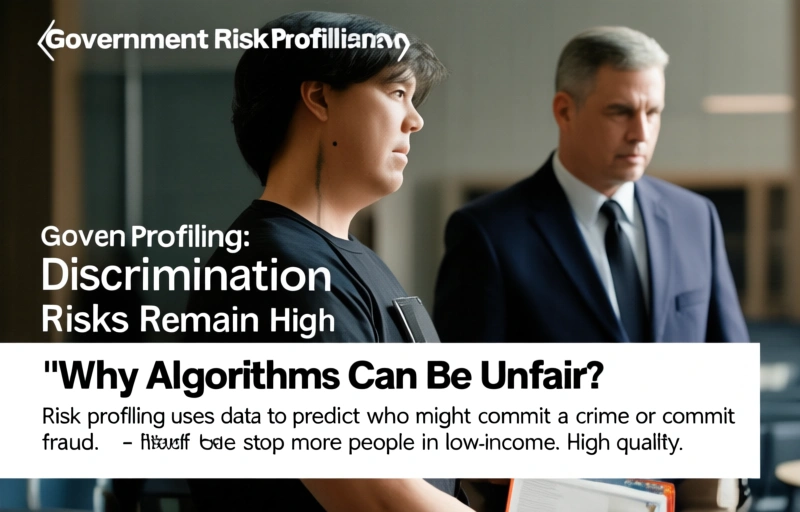
Government Risk Profiling: Discrimination Risks Remain High
Margriet Vermeer ·
Listen to this article~3 min

Government risk profiling can discriminate without clear rules. A new report warns that biased algorithms harm marginalized groups. Learn what principled measures can prevent this.
### The Problem with Risk Profiling
Government risk profiling sounds like a smart way to allocate resources. But without clear rules, it can cause real harm. A new report from the University of Amsterdam warns that these systems often discriminate against marginalized groups.
Think about it: when algorithms decide who gets pulled over or audited, they can amplify existing biases. The researchers argue that without principled measures, the risk of discrimination and harm remains too great. This isn't just a theory—it's happening right now.
### Why Algorithms Can Be Unfair
Risk profiling uses data to predict who might commit a crime or commit fraud. But the data itself can be flawed. For example:
- Police stop more people in low-income neighborhoods, creating a feedback loop.
- Credit scores and zip codes can serve as proxies for race or class.
- Past arrest records may reflect biased policing, not actual crime rates.
These systems don't just reflect society's problems—they can make them worse. A person flagged as high-risk might face more scrutiny, which then generates more data that confirms the original label.
### What Principled Measures Would Look Like
The researchers call for transparency and accountability. That means:
- **Independent audits** of profiling systems to check for bias.
- **Public reporting** on how algorithms perform across different groups.
- **Clear rules** about what data can be used and why.
Without these safeguards, profiling becomes a tool for discrimination. It's like using a map that only shows certain roads—you'll always end up in the same places, missing the bigger picture.
### The Human Cost
When the government gets profiling wrong, real people suffer. A single flag can lead to lost jobs, denied loans, or even wrongful arrests. The harm isn't just statistical—it's personal.
> "Without principled measures, the risk of discrimination and harm remains too great." — University of Amsterdam researchers
This isn't about being anti-technology. It's about being pro-justice. We can use data to improve safety and efficiency, but not at the expense of fairness.
### What You Can Do
If you work in policy or advocacy, here's how to push back:
- **Ask questions** about any profiling system your organization uses.
- **Demand transparency** from vendors and government agencies.
- **Support legislation** that restricts biased uses of data.
The bottom line: risk profiling isn't inherently bad. But without principled measures, it's a shortcut to discrimination. We need to slow down, think critically, and build systems that serve everyone—not just the data points that fit a model.
This conversation matters for anyone concerned about civil rights, privacy, and equality. The University of Amsterdam's report is a wake-up call. Let's not ignore it.