Racism, Politics, and Social Issues: The Tangled Truth
Margriet Vermeer ·
Listen to this article~4 min
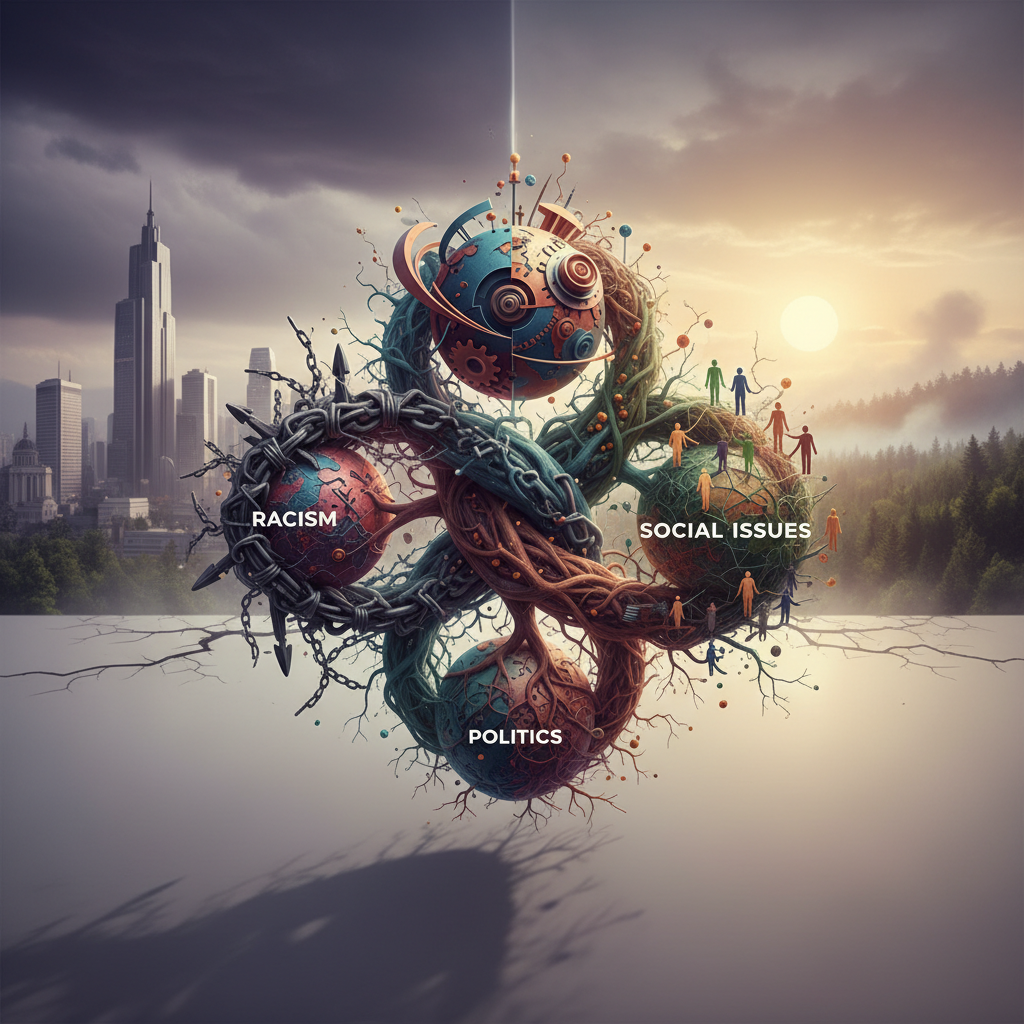
Racism, politics, and social issues are deeply connected. This article explores how systemic racism shapes political systems and social structures, and offers actionable steps for change.
You're probably wondering how racism, politics, and social issues all fit together. It's not a simple picture. Honestly? It's a messy, tangled web where each thread pulls on the others. Racism isn't just a personal prejudice anymore – it's baked into our political systems and social structures. And that's where things get really complicated.
### How Racism Shapes Politics
Examples of racism in politics are everywhere once you start looking. Take the 2020 protests. Racial justice examples like police reform became political flashpoints. Suddenly, everyone had an opinion on whether racism is a political opinion or a systemic issue. Spoiler: it's both. Here's the thing – when race and politics in America get discussed, people tend to pick sides. But it's not that simple.
Current racial issues in America aren't just about individual bigotry. They're about who gets to vote, who gets loans, who gets arrested. And that's where social issues come in. Because you can't separate racism from poverty, from education, from healthcare. They're all connected. It's like a knot – pull one thread and the whole thing tightens.
### The Uncomfortable Truth
Which brings me to an uncomfortable truth: we've been having the same conversations for decades. Police brutality. Economic inequality. School segregation. The names change, but the patterns don't. And that's frustrating. Because you want to believe progress is happening. But then you see another headline, another protest, another political fight over the same damn issues.
Here's what I've noticed in my years of studying this: we often treat these problems as separate. But they're not. Consider these real-world connections:
- **Voting rights**: Laws that restrict voting disproportionately affect communities of color, which then shapes who gets elected and what policies pass.
- **Housing**: Redlining and discriminatory lending practices from decades ago still determine who lives in what neighborhoods today.
- **Education**: School funding tied to property taxes means poorer areas – often with more minority residents – get fewer resources.
- **Healthcare**: Racial disparities in treatment and access lead to worse outcomes for Black and brown communities.
### Why It Feels Like We're Stuck
You might feel like we're spinning our wheels. That's because the system is designed to resist change. Political polarization makes it hard to have honest conversations. Social media amplifies extreme voices. And the complexity of it all can be overwhelming. But here's the thing: small actions add up.
> "The arc of the moral universe is long, but it bends toward justice." – Martin Luther King Jr.
That quote is hopeful, but it's not automatic. Bending takes effort. It takes people showing up, voting, organizing, and having uncomfortable conversations with family and friends.
### What You Can Do
If this resonates, share it with someone who needs to hear it. And if you want to dive deeper, check out local organizations working on racial justice – they're the ones making real change happen. Start by looking up groups in your city that focus on voter registration, police reform, or educational equity. Even a few hours a month can make a difference.
Remember: change doesn't happen overnight. But it does happen when enough people refuse to accept the status quo. The tangled web can be untangled – one thread at a time.