Why Racism, Politics, and Social Issues Are Inseparable
Margriet Vermeer ·
Listen to this article~5 min
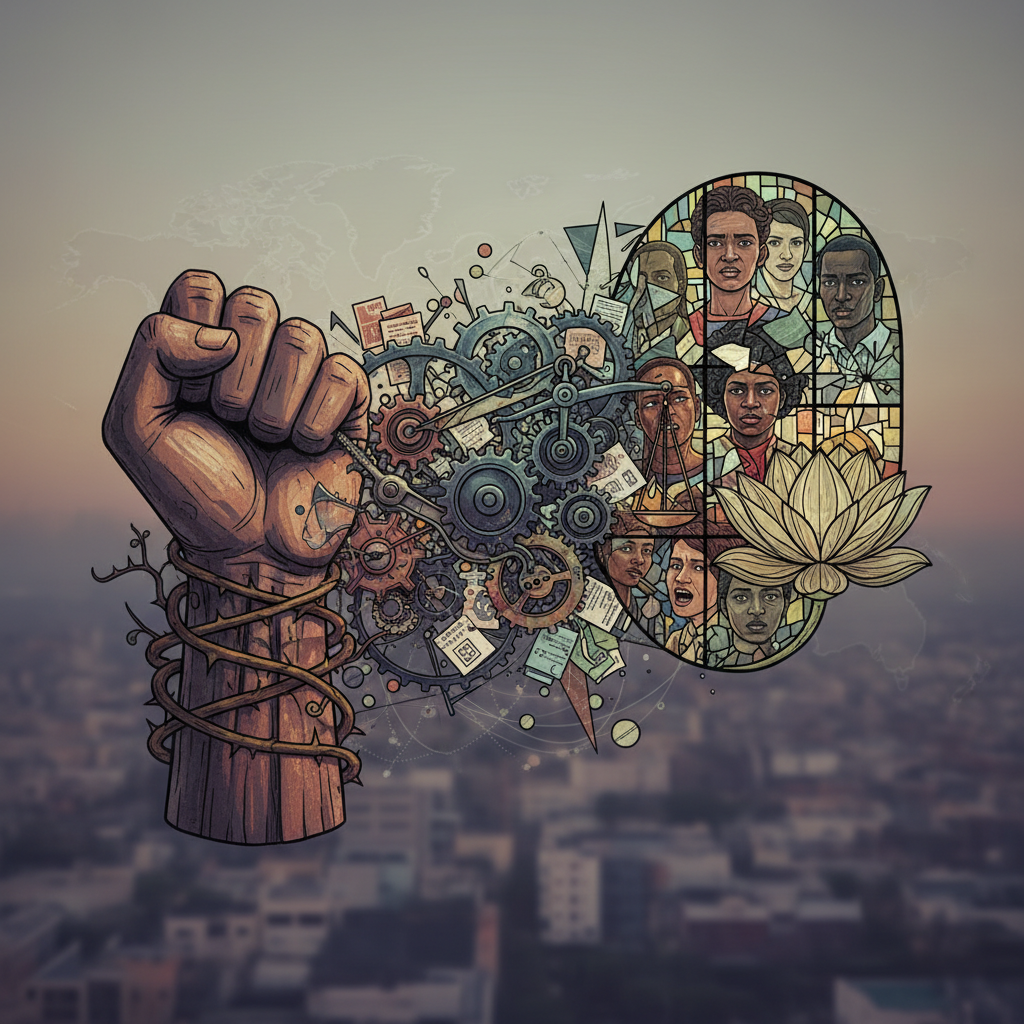
Racism isn't just individual prejudice—it's systemic, woven into political institutions and social structures. Understanding this inseparable link between race, politics, and social justice is crucial for meaningful change.
You've probably noticed it too. Conversations about racism almost immediately shift to politics and social justice. And honestly? That's because they're fundamentally connected. You can't pull them apart.
Racism isn't just about individual prejudice—it's a systemic force woven into the very fabric of our political institutions, economic policies, and social structures. To treat it as anything less is to miss the point completely. The real issue with racism is that it's never just about race; it's about power, access, and who gets to define the rules of the game.
### Is Race Political or Social? It's Both
Look, I understand the frustration. Sometimes it feels like everything's become politicized. But when we talk about race, that distinction between 'political' and 'social' starts to blur—then it disappears entirely.
Think about it for a moment. Housing policies (redlining comes to mind), school funding formulas, voting district maps, policing budgets, even environmental regulations about where factories get built... these are all political decisions with profound racial impacts. They're the machinery that either perpetuates or dismantles racial inequality.
A lot of people ask about the top social justice issues today. Racial justice consistently makes that list, and for good reason. It's the foundation. You can't meaningfully tackle economic inequality, healthcare access, or educational disparity without confronting the racial dimensions baked into them.
Current issues affecting the Black community—from wealth gaps to maternal mortality rates—aren't random accidents. They're the outcomes of specific political choices made over generations. That's why the question 'Is racism a social justice issue?' almost answers itself.
Of course it is. Social justice is about fair distribution and opportunity within a society. When systems are designed—whether intentionally or through neglect—to produce racially skewed outcomes, that's the very definition of a social justice problem.
As one community organizer recently told me: "The fight for racial justice is, at its core, a fight to recalibrate entire systems."
### How Racial Injustice Shows Up in Daily Life
We see the dramatic examples on the news—the protests, the court cases, the viral videos. But the real weight of racial injustice accumulates in the quiet, everyday experiences.
It's the micro-decisions that create a macro-problem:
- The job applicant with an 'ethnic-sounding' name who never gets a callback
- The higher interest rate on a mortgage for a family in a predominantly Black neighborhood
- The school curriculum that glosses over significant portions of history
These aren't just social slights—they're political outcomes. They stem from laws, policies, and institutional practices set in motion long before any of us were born.
Racial inequality becomes self-reinforcing. Limited access to quality education (a social issue influenced by local politics) leads to constrained job prospects. That leads to lower wealth accumulation. Lower wealth affects where you can live, which circles back to school quality for your children. It's a cycle that requires deliberate political will to break.
### Practical Steps Forward
So where does this leave us? Honestly, it can feel overwhelming. The knot of racism, politics, and social issues is tight and complex. Pulling on one thread sometimes seems to tighten another.
The key—and this is crucial—is to stop thinking of them as separate threads. They're all part of the same cord. Progress happens when our approach becomes integrated.
Supporting a social program for community development? That's great. Now, who's advocating for the political funding to sustain it? Calling out an instance of individual prejudice? Absolutely necessary. Now, what policies need changing to prevent it from happening again?
The work of addressing racial justice is practical, grounded work. It's policy work, budget work, legislative work. It requires showing up at local school board meetings, understanding how zoning laws affect housing, and recognizing how historical decisions continue to shape present realities.
It's not about finding a single solution, but about committing to the ongoing work of untangling systems that were centuries in the making. And that work begins with understanding that racism, politics, and social issues aren't just linked—they're fundamentally inseparable.